Launch offer — valid today only

The FAA Commercial Pilot (CAX) Knowledge Test in 76 Illustrated Topics One Topic per Page, Every Chart Worked in the Same Steps

Load factor, the V-g diagram, constant-speed props, density altitude, weight and balance, fronts, oxygen rules and the 61.129 hours: in the handbooks it's a wall of text. Here each topic fits on one page, with the drawing and what you need to remember. 81 illustrated pages.

STUDY IT WITH DRAWINGS

🔒 Secure checkout · PDF by email · 30-day guarantee

One topic per pagethe drawing teaches you the rule and the text backs it up
81 illustrated pages9 parts, from the CAX test itself to test day
Up-to-date sourcesCommercial Pilot ACS (FAA-S-ACS-7B), PHAK and 14 CFR Parts 61 and 91

This Is What the Pages You Will Study Look Like

One topic per page, the drawing that shows you how it works, and boxes with what you need to know:

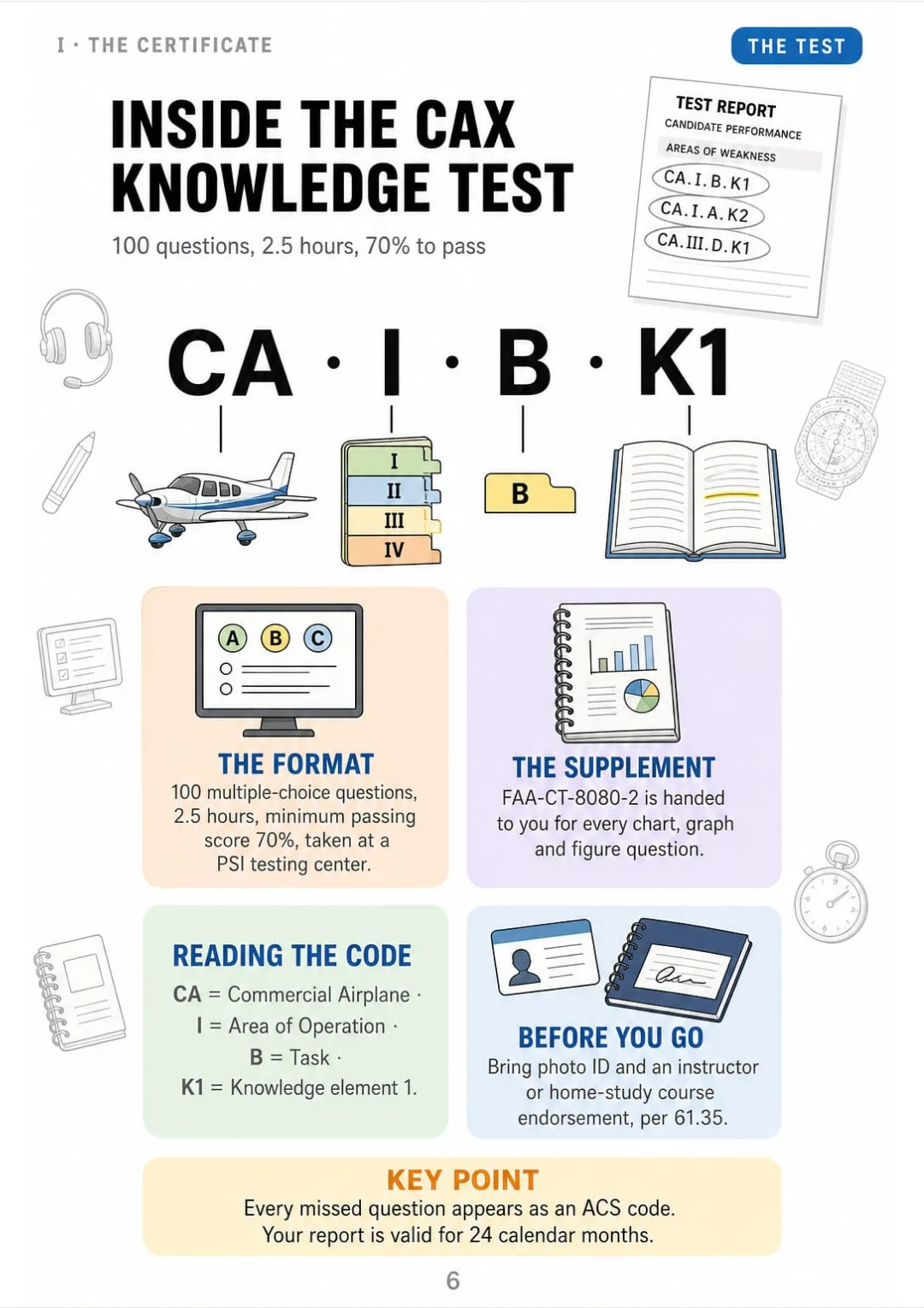
CAX: 100 questions, 2.5 hours, 70% to pass, report valid 24 calendar months
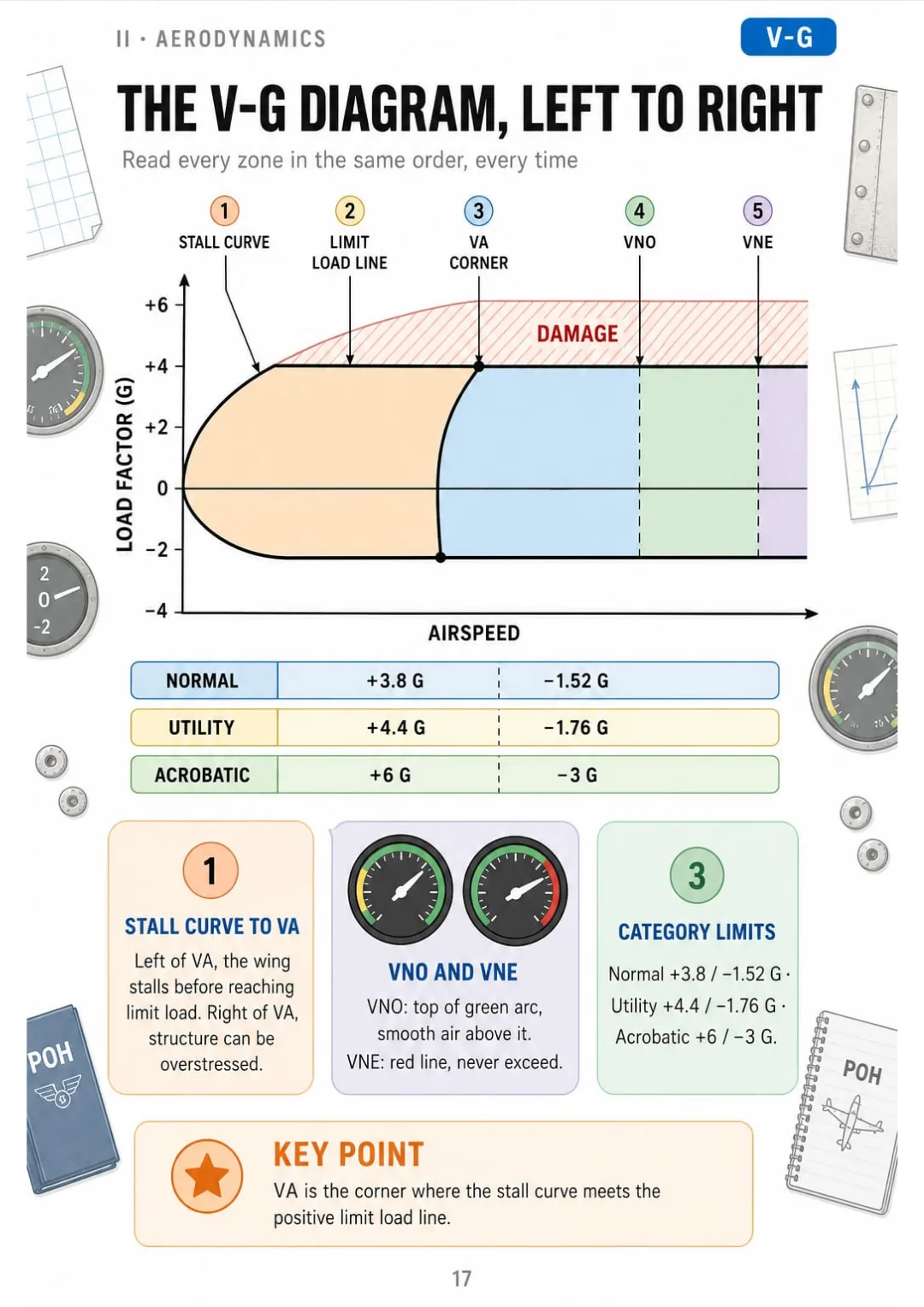
Stall curve, limit load, VA, VNO, VNE: normal category +3.8 / −1.52 G.
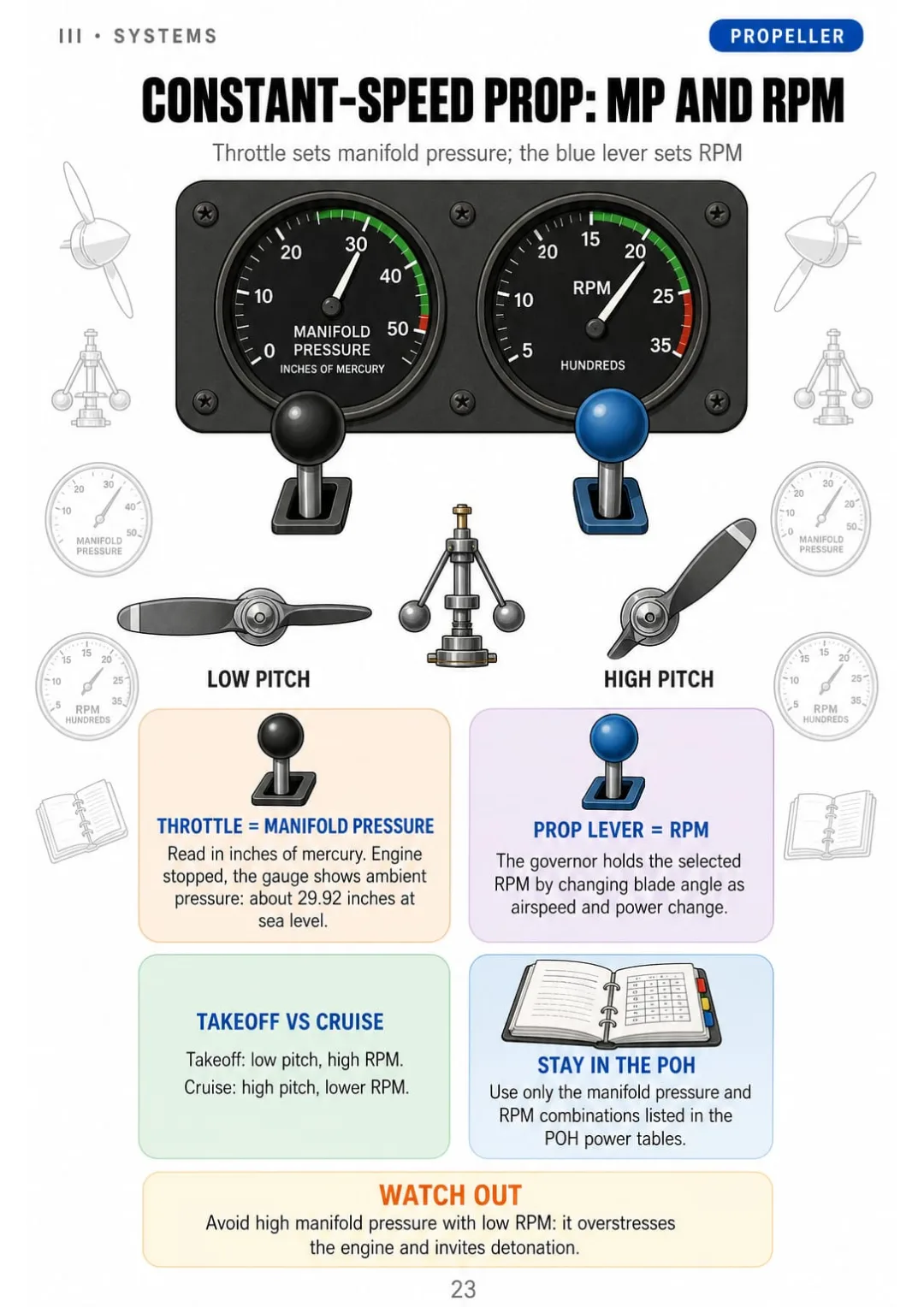
Throttle → manifold pressure (in. Hg) · Blue lever → RPM · Governor changes blade angle
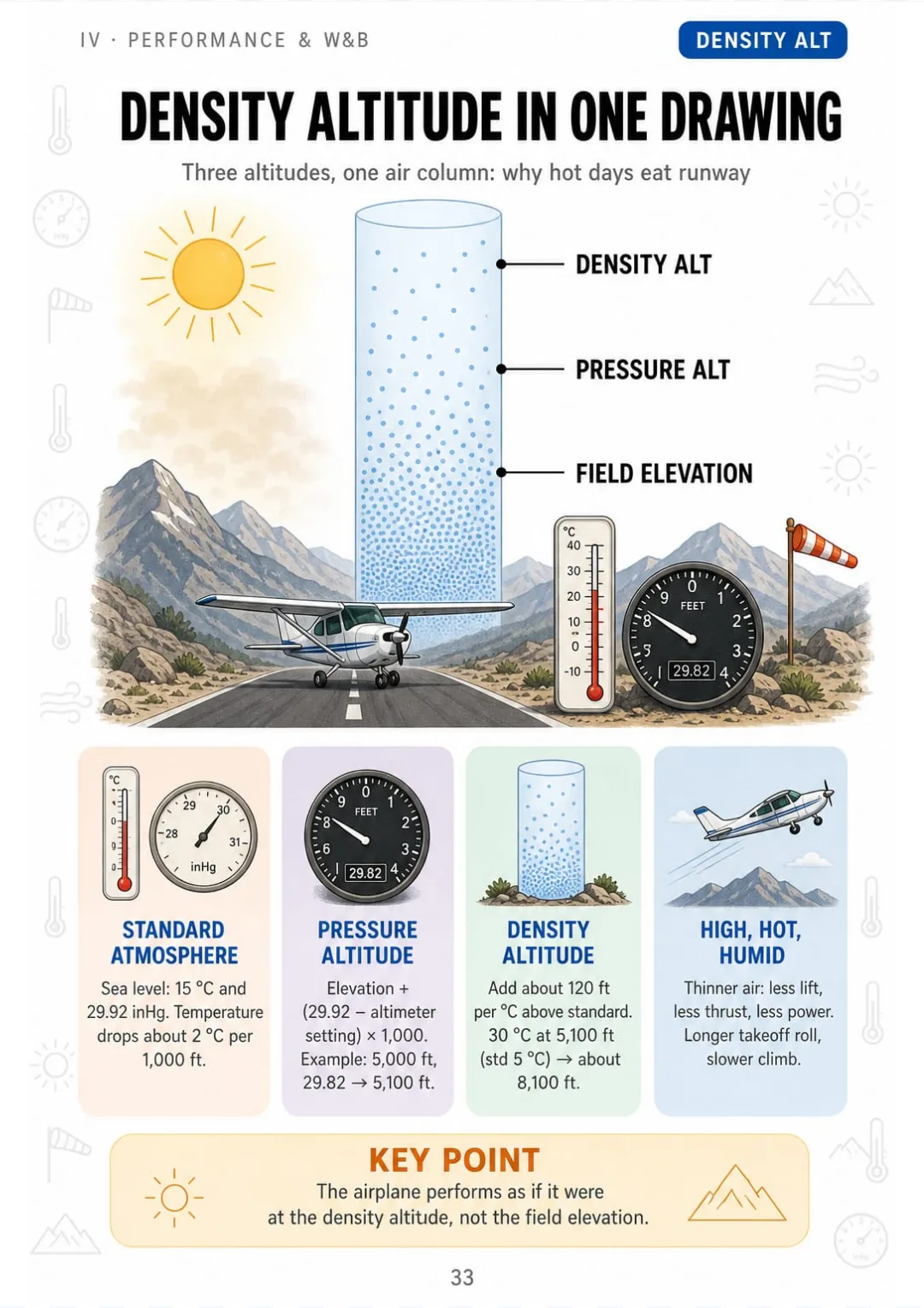
Pressure altitude = elevation + (29.92 − setting) × 1,000; add 120 ft per °C above standard.
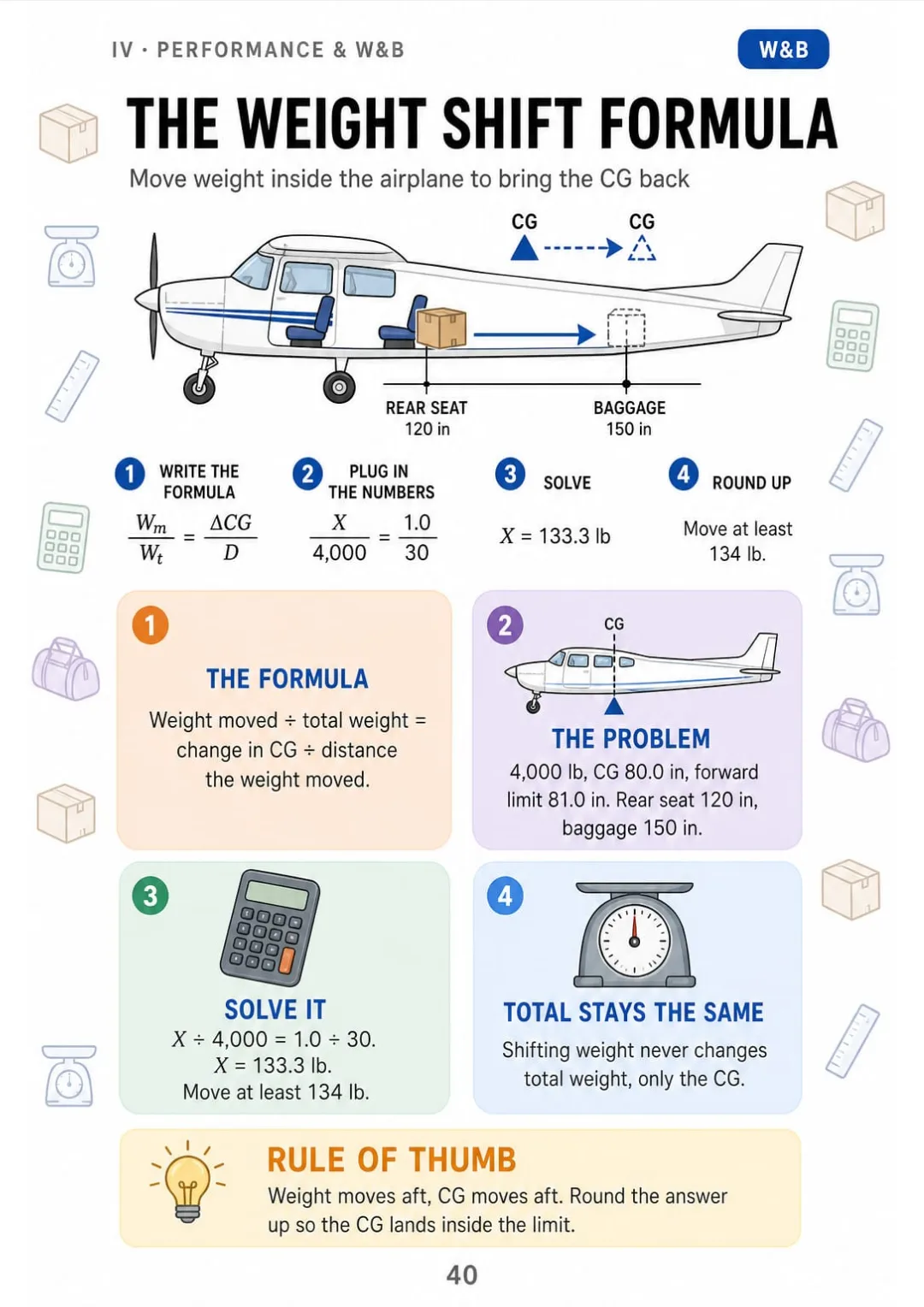
Weight moved ÷ total weight = CG change ÷ distance moved.
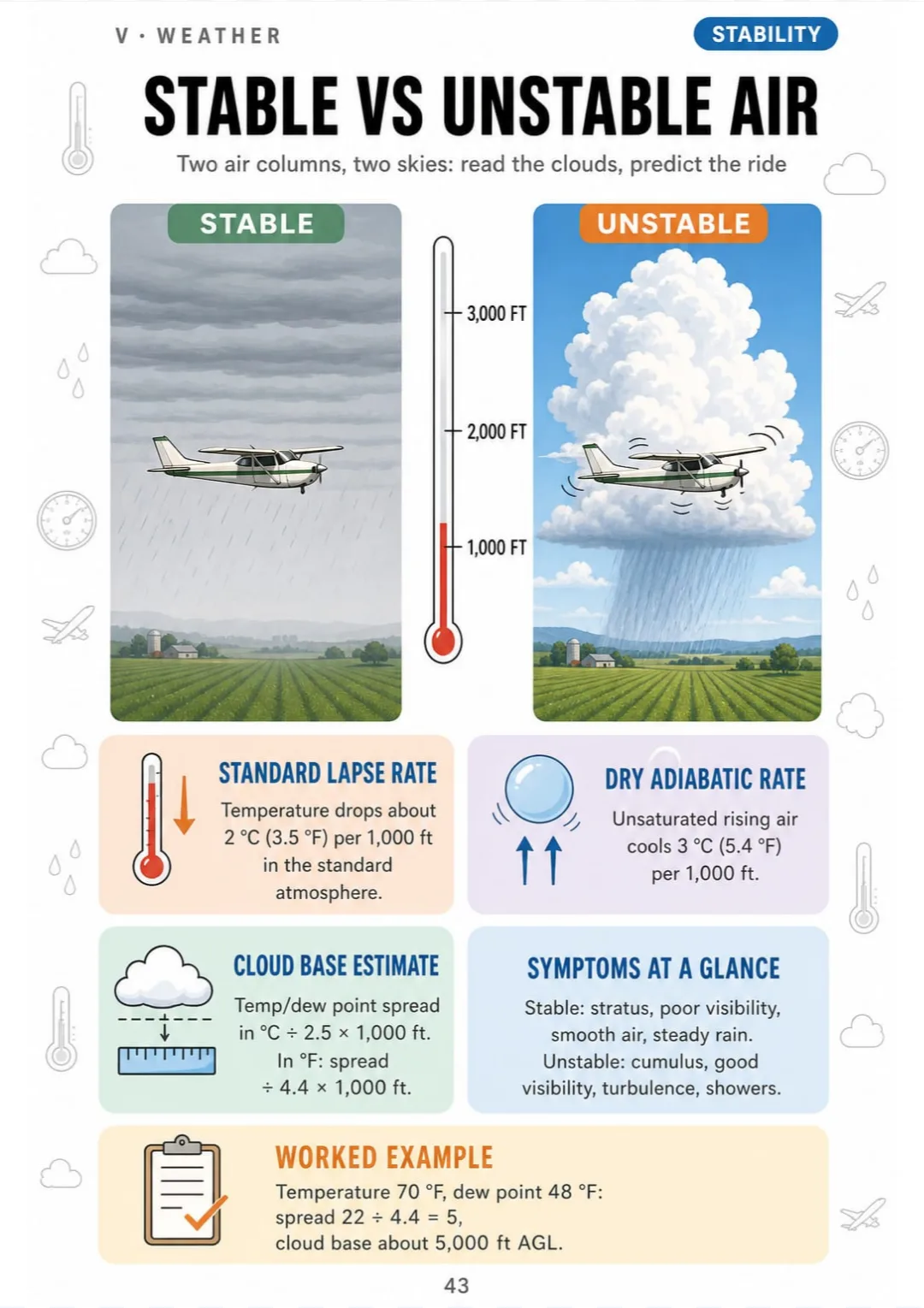
Stable air: stratus and smooth. Unstable air: cumulus and bumps. Cloud base = spread ÷ 4.4 × 1,000 ft.
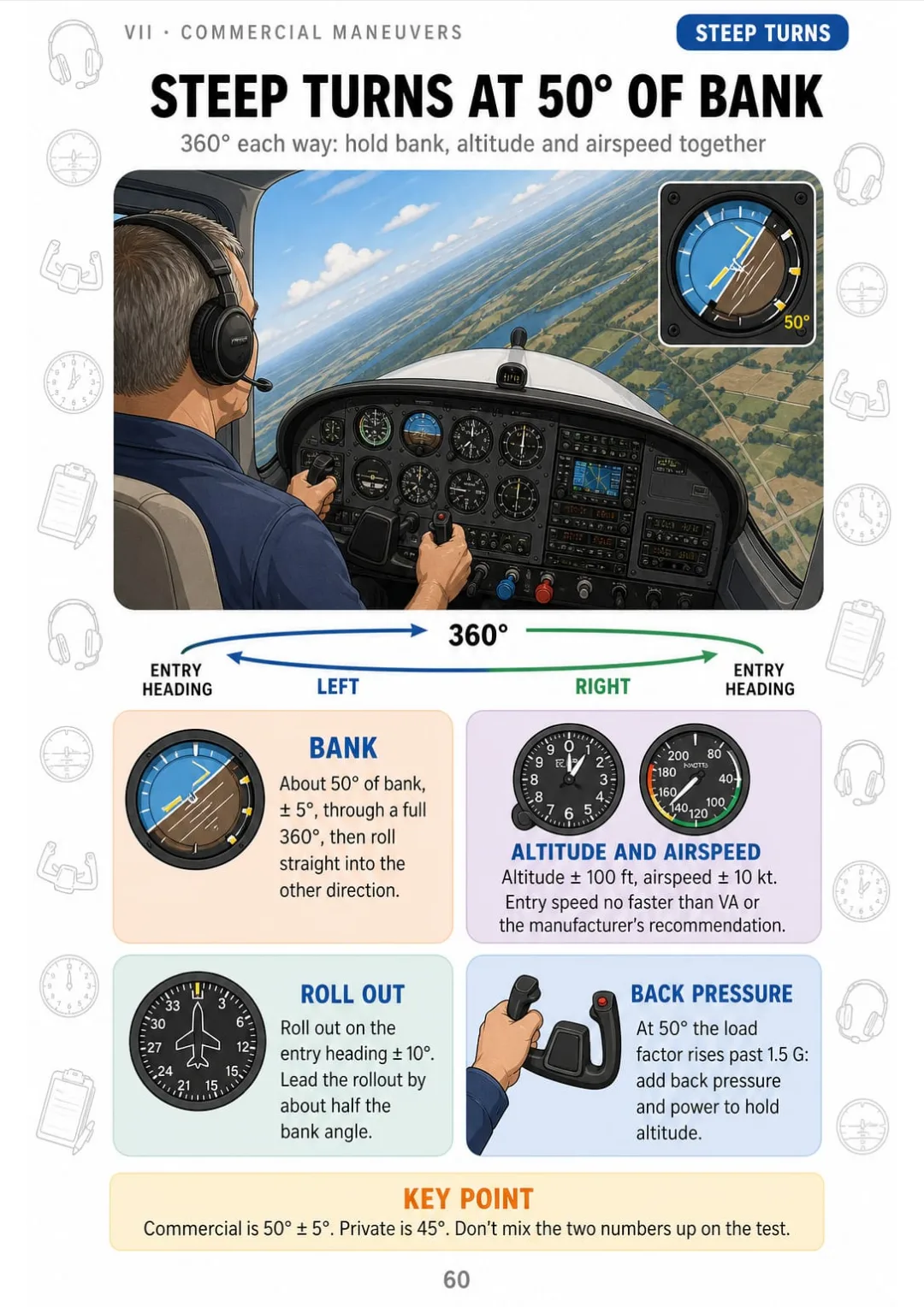
Steep turns: 360° at 50° ± 5°, altitude ± 100 ft, airspeed ± 10 kt, heading ± 10°.
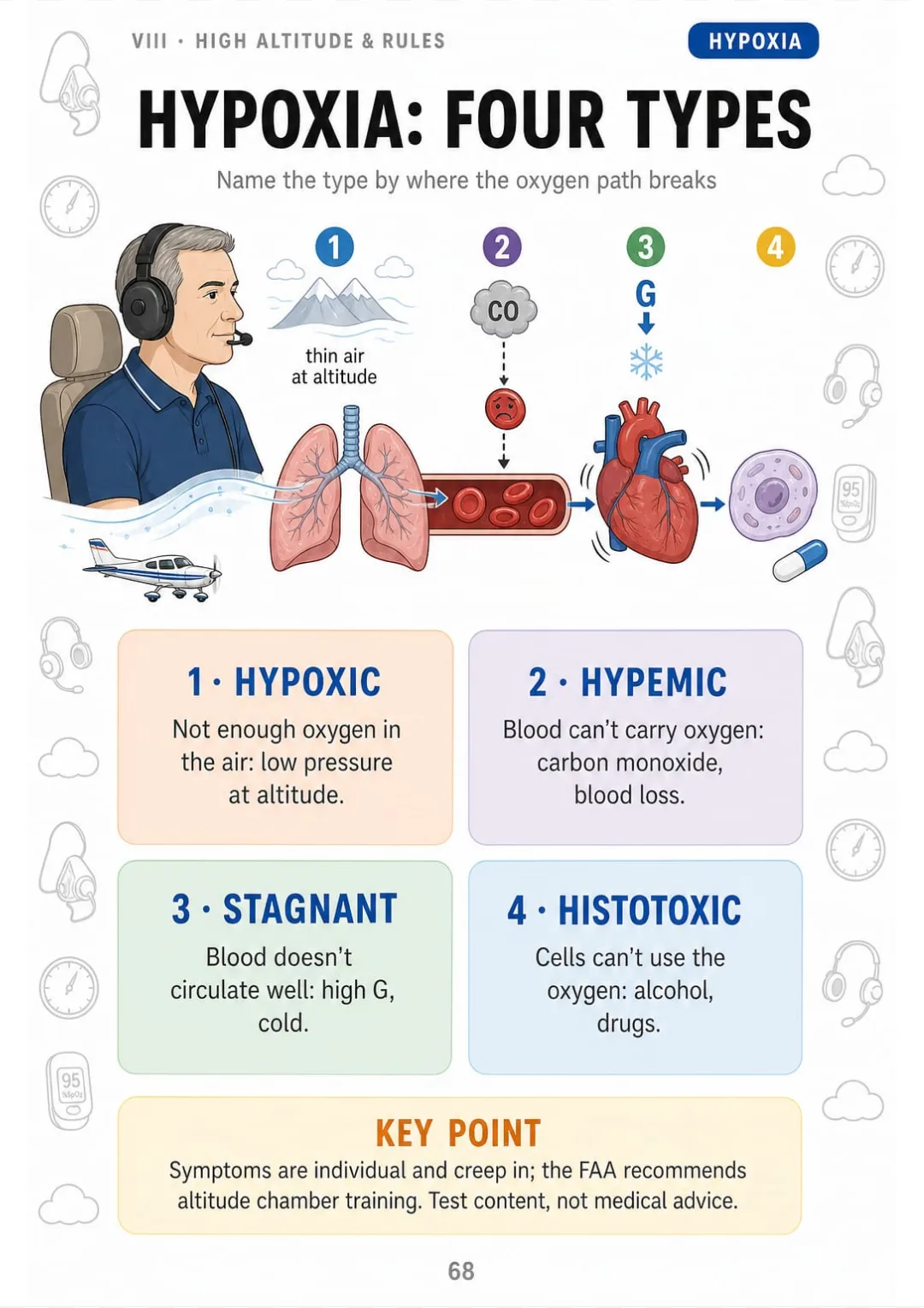
Hypoxic, hypemic, stagnant, histotoxic: where the oxygen path breaks

Swipe to see more →

These are real pages from the book. The table of contents is the full one: 9 parts and 76 topics.

It's Not That You Have a Bad Memory. It's That No One Ever Put It in Order.

You've read the constant-speed prop section three times. You close the handbook...

...and you can't say which lever sets what, or what the governor actually does. It was just lines of text.

Throttle → manifold pressure (in. Hg) · Blue lever → RPM · Governor changes blade angle

Here the constant-speed prop is one drawing: the throttle and its manifold pressure in inches of mercury, the blue lever and its RPM, and the governor changing the blade angle between them.

And the same treatment for what eats your evenings: takeoff distance and cruise charts worked in the same steps, and weight and balance from weight, arm and moment to the new CG after you burn fuel.

First you understand why it works that way. Then the order sticks on its own.

SEE THE DIFFERENCE

Stop memorizing aerodynamics you can't picture:

THIS
  • Pages and pages of dense text
  • Figures scattered across chapters, with no order to follow
  • On test day, you don't know where to start
In steady, unaccelerated flight, the opposing forces acting on the airplane are in equilibrium: lift equals weight and thrust equals drag. Total drag is the sum of parasite drag, comprising form drag, interference drag and skin friction, which increases with the square of airspeed, and induced drag, a by-product of lift generation, which decreases as airspeed increases. The airspeed at which the two curves intersect corresponds to minimum total drag and, therefore, to the maximum lift-to-drag ratio, L/D max.
FOR THIS
  • Every concept drawn
  • One topic per page, with the rules in boxes
  • You remember it because you've seen it
Stall curve, limit load, VA, VNO, VNE: normal category +3.8 / −1.52 G.
CONTENTS

Take a Look at the 9 Parts and 76 Topics

The certificate and the rules, aerodynamics and load factor, complex systems, performance and weight & balance, weather, navigation, the commercial maneuvers, high altitude and human factors, and the final review: 81 pages, all illustrated

IThe Certificate and the Rules for You · pp. 6-12
  1. Inside the CAX Knowledge Test
  2. What It Takes to Earn the Certificate: 61.129
  3. Commercial Privileges and Limitations: 61.133
  4. Without an Instrument Rating: 50 NM and Night
  5. Holding Out vs Common Carriage
  6. Part 91 vs Parts 119 and 135: What You Can Fly for Hire
  7. Medical Classes and How Long They Last
IIAerodynamics and Load Factor · pp. 13-22
  1. The Four Forces and Angle of Attack
  2. The Lift Equation in One Drawing
  3. Load Factor in Turns: 60° = 2 G
  4. Maneuvering Speed and How Weight Changes It
  5. The V-g Diagram
  6. Stalls, Spins and Accelerated Stalls
  7. Ground Effect
  8. Left-Turning Tendencies
  9. Stability: Longitudinal, Lateral and Directional
  10. Turn Rate and Radius vs Airspeed
IIIComplex and High-Performance Systems · pp. 23-32
  1. Constant-Speed Prop: Manifold Pressure and RPM
  2. Power Changes: The Lever Sequence
  3. Mixture, Detonation and Preignition
  4. Turbocharging and Critical Altitude
  5. Retractable Gear: Warnings and Emergency Extension
  6. Flaps and Flap Types
  7. Fuel Systems and Fuel Grades
  8. Electrical System and Alternator Failure
  9. Pressurization and Cabin Altitude
  10. Ice Protection Systems
IVPerformance and Weight & Balance · pp. 33-42
  1. Density Altitude in One Drawing
  2. The Takeoff Distance Chart, Step by Step
  3. The Landing Distance Chart
  4. Climb and Cruise Performance Tables
  5. Range and Endurance
  6. Crosswind and Headwind Components
  7. Weight, Arm, Moment and CG
  8. The Weight Shift Formula
  9. Adding or Removing Weight
  10. CG Limits: Forward vs Aft
VWeather and Weather Services · pp. 43-51
  1. Stability and Lapse Rates
  2. Fronts in Cross-Section
  3. The Thunderstorm Life Cycle
  4. Icing and Freezing Rain
  5. Fog: Five Types, One Cause Each
  6. Wind Shear, Microbursts and Mountain Waves
  7. Decoding a METAR and a TAF
  8. GFA, AIRMETs, SIGMETs and Convective SIGMETs
  9. Winds and Temperatures Aloft
VINavigation and Cross-Country Planning · pp. 52-59
  1. Sectional Chart Symbols
  2. Airspace Classes Side by Side
  3. Special Use Airspace and TFRs
  4. From True Course to Compass Heading
  5. The Wind Triangle and the E6B
  6. VOR, GPS and Time-Distance Problems
  7. VFR Fuel Requirements, Day and Night
  8. The Chart Supplement
VIIThe Commercial Maneuvers · pp. 60-67
  1. Steep Turns
  2. The Steep Spiral
  3. Chandelles
  4. Lazy Eights
  5. Eights on Pylons and Pivotal Altitude
  6. The Power-Off 180° Accuracy Approach
  7. Short-Field and Soft-Field Takeoffs and Landings
  8. Emergency Descent and Best Glide
VIIIHigh Altitude, Human Factors and Regulations · pp. 68-77
  1. Hypoxia: Four Types
  2. Oxygen Rules: 12,500, 14,000 and 15,000 ft
  3. Decompression and Time of Useful Consciousness
  4. Spatial Disorientation and Visual Illusions
  5. ADM, Hazardous Attitudes and Single-Pilot Resource Management
  6. Required Inspections: Annual, 100-Hour and the Rest
  7. Inoperative Equipment: 91.213
  8. Right-of-Way, Minimum Altitudes and VFR Weather Minimums
  9. Night Operations and Aircraft Lighting
  10. NTSB 830: What to Report and When
IXFinal Review and Test Day · pp. 78-81
  1. The Look-Alike Numbers, Side by Side
  2. The Most Frequent Mix-Ups
  3. Your Repeatable Methods on One Page
  4. Test Day Checklist

What If Every Topic Fit on a Single Page?

Imagine this:

Instead of rereading half a page on the V-g diagram without being able to see it...

...you open the page and find the whole envelope in one drawing: the stall lines, maneuvering speed, the limit load factors and the redline, each one labeled.

Weight moved ÷ total weight = CG change ÷ distance moved.

And load factor, density altitude, weight and balance, the oxygen rules and the 61.129 hours turn into drawings and tables you can read at a glance.

You stop repeating and start understanding.

That's exactly what Commercial Pilot Made Visual does. It's not “just another manual.” It's 9 parts and 76 illustrated topics, and at the end the look-alike numbers side by side, your repeatable methods on one page and a test day checklist.

Because what your brain sees organized, it remembers.

Here Is What You Get with Commercial Pilot Made Visual:

Ipp. 6-12

The Certificate and the Rules for You

Know what you're walking into: the CAX format, the 61.129 hours, commercial privileges and the 50 NM / night limit without an instrument rating, holding out vs. common carriage, Part 91 vs. 135 and medical classes.

IIpp. 13-22

Aerodynamics and Load Factor

See why the airplane does what it does: the four forces, load factor in turns, maneuvering speed vs. weight, the V-g diagram, stalls and spins, ground effect, left-turning tendencies and stability.

IIIpp. 23-32

Complex and High-Performance Systems

Run every complex system in the same order: the constant-speed prop, the power-change lever sequence, mixture and detonation, turbocharging, retractable gear, fuel, electrical, pressurization and ice protection.

IVpp. 33-42

Performance and Weight & Balance

Work every chart in the same steps: density altitude, takeoff and landing distances, climb and cruise tables, crosswind components, and weight and balance from arm and moment to CG limits.

Vpp. 43-51

Weather and Weather Services

Read the sky and the reports at a glance: stability and lapse rates, fronts, thunderstorms, icing, the five types of fog, wind shear, METARs and TAFs, the GFA, AIRMETs and SIGMETs.

VIpp. 52-59

Navigation and Cross-Country Planning

Plan a cross-country without guessing: sectional symbols, airspace classes side by side, special use airspace and TFRs, true course to compass heading, the wind triangle and the E6B, VOR and GPS, and VFR fuel rules.

VIIpp. 60-67

The Commercial Maneuvers

Picture each commercial maneuver before you fly it: steep turns, the steep spiral, chandelles, lazy eights, eights on pylons, the power-off 180, short- and soft-field takeoffs and landings, and emergency descent.

VIIIpp. 68-77

High Altitude, Human Factors and Regulations

Have the rules ready when someone asks: hypoxia and the oxygen rules, spatial disorientation, ADM and SRM, required inspections, 91.213, right-of-way, VFR minimums, night lighting and NTSB 830.

IXpp. 78-81

Final Review and Test Day

Walk into the test with it all on a few pages: the look-alike numbers side by side, the most frequent mix-ups, your repeatable methods on one page and the test day checklist.

At the end of the book: The look-alike numbers side by side, your repeatable methods on one page and a test day checklist.


And That Is Not All: 2 More Books, Free

Commercial Performance Chart Drills

BONUS 1: «Commercial Performance Chart Drills»

Value on its own: US$ 17.90

Practice on redrawn takeoff, landing, cruise, crosswind and weight and balance charts, with every answer worked out in the same steps as the book, so reading a performance chart under time pressure becomes routine.

Common CAX Mix-Ups and Test Day Checklist

BONUS 2: «Common CAX Mix-Ups and Test Day Checklist»

Value on its own: US$ 14.90

Quick-review cards that put the look-alikes side by side (chandelle vs lazy eight, detonation vs preignition, 12,500 vs 14,000 vs 15,000 ft, the 61.129 hour buckets), plus what you need on test day: your endorsement, PSI registration and what to bring.

Commercial Pilot Made Visual + 2 Free Books

  • Commercial Pilot Made Visual: 81 illustrated pagesUS$ 63
  • BONUS 1: Commercial Performance Chart DrillsUS$ 17.90
  • BONUS 2: Common CAX Mix-Ups and Test Day ChecklistUS$ 14.90
  • High-resolution PDF to printIncluded
Total value US$ 95.80
YOUR PRICE:
US$ 27
You save US$ 68.80
YES, I WANT COMMERCIAL PILOT MADE VISUAL FOR US$ 27

📄 This is a digital PDF book sent to your email: nothing is printed or shipped.

Secure purchaseEncrypted payment30-day guarantee

PDF by email: Commercial Pilot Made Visual reaches your inbox as a PDF, and the two free books come by email too. One-time payment, no installments or hidden costs.

Is This Book for You?

You're going for your commercial alongside another job

You're going for your commercial alongside another job

Aerodynamics, systems, performance and regs, one topic per page, to review at night or between flights.

Your test or checkride is close

Your test or checkride is close

A final review of everything the test covers, with the look-alike numbers side by side and every chart worked in the same steps.

You already fly commercially or instruct

You already fly commercially or instruct

A quick visual review of what comes up all the time: 61.133 privileges, the oxygen rules, 91.213 and the commercial maneuvers.

To Sum Up: Here Is What You Get

US$ 95.80US$ 27
YES, I WANT COMMERCIAL PILOT MADE VISUAL FOR US$ 27

📄 This is a digital PDF book sent to your email: nothing is printed or shipped.

30DAYS
GUARANTEE

30-Day Guarantee

30-day guarantee: tell us what didn't work and we'll refund 100%.

You have 30 days to try Commercial Pilot Made Visual and the two bonus books. If it doesn't work for you, tell us what didn't work and we'll refund 100% of what you paid. One-time payment, no subscription.

Frequently Asked Questions

How do I get the material?

You get Commercial Pilot Made Visual as a high-resolution PDF by email, at the address you enter at checkout. The two bonus books, Commercial Performance Chart Drills and Common CAX Mix-Ups and Test Day Checklist, come by email too.

Is it a monthly payment or a one-time payment?

One-time payment of $27. No installments, no subscription.

Who is it for?

For private pilots, usually already instrument rated, preparing for the FAA Commercial Pilot – Airplane knowledge test (CAX) and the checkride. It's not a beginner book: it starts at the commercial level. Check the table of contents above to see the topics.

What sources is it based on?

The current editions of: the Commercial Pilot – Airplane ACS (FAA-S-ACS-7B), the Pilot's Handbook of Aeronautical Knowledge, the Airplane Flying Handbook, the Aviation Weather Handbook, the AIM, 14 CFR Parts 61 and 91, 49 CFR Part 830 and the Airman Knowledge Testing Supplement (FAA-CT-8080-2). Each page was checked against them.

Is it official FAA material?

No. It's an independent study book, not affiliated with or endorsed by the FAA or PSI. Performance charts are redrawn with sample data, and chart excerpts are marked “Not for navigation.”

Does it replace ground school or a CFI?

No. It's a study and review tool, and it doesn't give you the knowledge test endorsement: you still get that from your CFI or an authorized ground school. It doesn't replace their instruction, your airplane's POH or the current regulations. Hypoxia and spatial disorientation are covered as test content, not as medical advice.

Are the practice questions the ones on the test?

No. The chart drills and practice items are written for this book. They're not official FAA test questions: they're there to train you.

Can I print it?

Yes. The PDF prints at home or at a copy shop, so you can keep it in your flight bag.

What if I don't like it?

You have 30 days: tell us what didn't work and we'll refund 100%.

One Last Thing Before You Decide...

You don't have to reread the same page hoping this time it sticks.

You don't have to memorize aerodynamics you can't picture.

And you definitely don't have to walk into the test not knowing where to start.

There's an easier way. And it's one click away. Now it's your turn.

One-time payment: US$ 27 · Guarantee: 30 days · PDF by email

YES, I WANT COMMERCIAL PILOT MADE VISUAL FOR US$ 27

📄 This is a digital PDF book sent to your email: nothing is printed or shipped.